The Taiji Ruler, or Tai Chi Ruler is both a tool and a form, or set of movements used to focus the mind while cultivating and moving Qi.
Use of the Taiji Ruler became popular in China in the 1950's although some claim that the Taoist practice dates back to 900 CE.
What it's not:
It's not a measuring stick. Well, it is in a way.
It's not a magical wand that directs Qi. Well, it is in a way.
The Taiji Ruler is a stick or dowel which measures eight to twelve inches. It is most often made of wood. I have made simple Rulers and have purchased a somewhat more traditional Ruler.
The traditional Ruler is symmetrically shaped to resemble two sword handles. The round center is used as a focal point.
In the photo above you'll see the traditional Ruler, a Ruler that I made out of a half inch dowel with round end caps, and a simple Ruler made from a cut up broom stick. I made twelve Rulers pictured in the middle for my fellow practitioners in my Qigong in a Park group.
Well,"in a way:"
While the Taiji Ruler does not have inches or centimeters designated, it is indeed a measuring stick, measuring the width of the side channels of the body. It should roughly measure the distance between two points in Kua, the inguinal crease, and also the shoulder nests.
We often refer to the Kua during practices. We move from the Kua, we settle into the Kua. The Kua is home to many lymph nodes. The Kua supports immunity and also our urogenital health.
The "Shoulder Nests" also called "Crow's Nests" are located below the collarbones in the hollows near the shoulder. These nests are home to two very important acupressure points: Lung 1 and Lung 2. The lung points also support immunity and also lung health.
We hold the Ruler between our palms at a point called Laogong. This point is also known as the "Palace of Toil." It is the eighth point of the heart protector or pericardium meridian. Stimulating it eases anxiety and clears inflammation. Bodyworkers and healers up their game by focusing attention on the Laogong point.
Find the Laogong point by making a loose fist. The point is near where your middle finger meets your palm.
The Laogong:
Removes excess heat in the body.
Relieves mouth or tongue ulcers and cold sores.
Reduces fever.
Increases internal energy.
Calms a restless mind.
Warms cold hands.
If there is an imbalance in your Fire Element which is housed in your heart, you may feel depressed and without joy in your life. Stimulating the Laogong can restore your vitality and happiness while also protecting your heart.
I will spare you by not explaining the forms practiced with the Taiji Ruler. The movements are flowing, circular and meditative. There are plenty of lovely videos on YouTube.
My favorite way to practice Taiji Ruler forms is first with the Ruler, and then without, holding the hands at the same width and energetically connecting the Laogong points.
I love this Primordial Tai Chi Ruler video because of the simplicity. He picks up a stick laying on the ground and practices the forms with ease.
And a slightly more involved practice with detailed descriptions of the forms:
While thinking about a catchy phrase to introduce this post, I pondered the most common cliché: "practice makes perfect." As a musician and a practitioner of Qigong, I've got to say, nope, I'm not buying it. I've spent my life practicing. Have I achieved perfection? Nope.
"How do you get to Carnegie Hall?"
My most recent Qigong obsession has taught me the meaning of the word practice.
When I am leading a Qigong practice, I introduce myself not as a teacher, but a fellow practitioner. "I'm here to practice with you." Like I say over there in my bio, the learning never stops.
I don't assume the role of an expert, or someone who has achieved perfection.
Assuming that role of expert I will:
1. Create unreasonable expectations.
2. Inhibit my own experience.
3. Stunt my growth.
4. Make it about the role and not the experience.
5.
6.
As a practitioner I'm going to forget something, make a mistake and correct it, or, I might just let the mistake be MY secret and learn from it. But, I'll also gain some new insights about the forms we're practicing, and I'll grow.
We practice together. We laugh at our slip-ups, or our uncoordinated moments, or we laugh at the notion that next time it will be perfect. We keep going, enjoying the experience. We go with the flow.
We might even have what I refer to as our:
AH HA! moments.
Let's look at a practice called "Teacups." I've practiced teacups with groups of high school students to introduce mindfulness and focus. The first practice that I led "In a Park" included this right brain/left brain, mindfulness exercise. It is tricky. And, it's fun.
Shifu Orlando Schiaffino introduces and demonstrates "Teacup Qigong:"
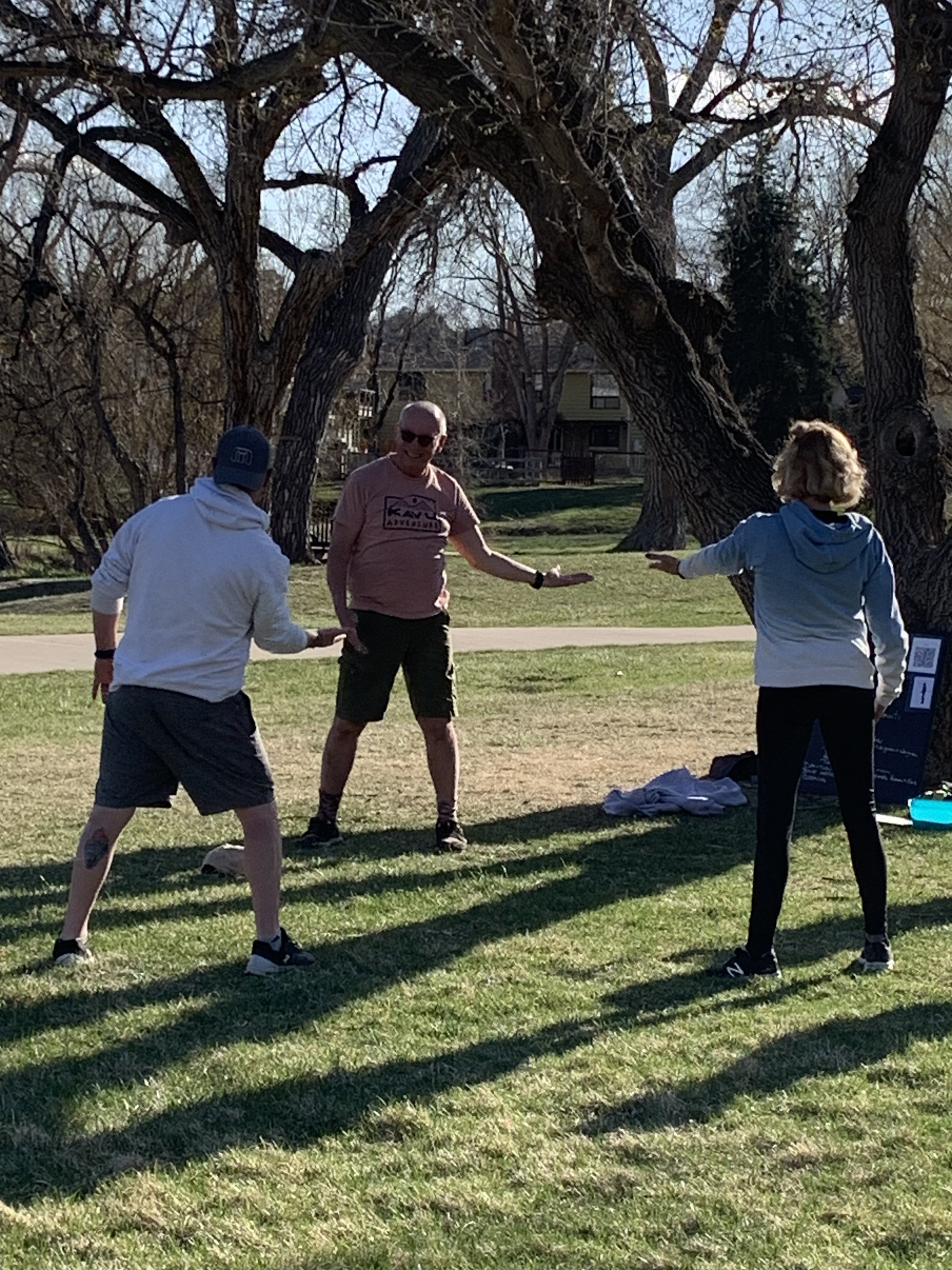
Does it have to be perfect? Let's take a look at some photos of my good buddy Erik practicing "Teacups" with me "In a Park." He's with me, he's doing it, and then crash, he loses it and we all laugh and he does his own dance. Do your dance Erik. Have fun!
In a couple of days I will be practicing "Teacups" with friends as an expression of spiraling and reaching upwards. The movements of Spring. Just like a seed, when nurtured by water and sun, spirals upwards out of the earth and up, up, up.
What am I doing here? I'm hoping to spark some interest and dispel fear. I'm hoping to motivate and inspire not just a group of friends, but also myself! Let's do this!
Learning about learning:
When I was going through a Qigong teacher training with Nick Loffree, I diligently attended every Zoom practice and lecture. I practiced along with videos. I heard other students give feedback. But then when it was time to prepare for my private lessons with Nick, where he would be evaluating my skills, I realized I hadn't integrated these practices.
So, I went back and studied. I watched his videos. I took copious notes. I broke down each form so that I could gain some inspiration. I practiced without his videos and his Zoom classes. I used my notes. I put the notes aside. But, still, I had just memorized his techniques, his moves. They weren't mine, yet.
It wasn't until I started practicing with others that the forms began to resonate.
They were becoming my forms that I could share with others. I found I was having "AH HA"moments.
With patience and discipline, productive practice time creates "AH HA" moments.
To achieve this state of revelation, you can't be looking for the "AH HA" moment. It has to come to you organically. Great boss, how do we do that?
Believe me, after decades of teaching music I have learned that the first step is inspiration. What piece of music will resonate with them? How can I get them excited about learning something that they simply need to learn? Once I have ignited a spark of interest, we learn. We learn by:
Becoming inspired
Imitating
Evaluating
Correcting
Slowing down
Breaking apart
Studying
Imitating someone else
Changing our perspective
Looking at things differently
Studying some more
Patting ourselves on the back
Correcting some details we hadn't noticed before
Succeeding
Practicing our successes
Making it our own!
Repeat
The other day I was practicing a Qigong/Neigong form ("Neigong," that's for another time) called "From Sprouting to Blooming." The name itself conjures images of Spring, and growth. Nice.
Being a seemingly simple Qigong form, I went through the movements, focused my breathing, all the stuff. And then thought, "I'm going to try it with my Taiji Ruler," a beautiful piece of wood held between the hands. I wrote a post about the TAIJI RULER. Check it out. Having the Ruler between my palms changed my perspective, gave me a slightly different focus.
Boom, the form changed. I had my"AH HA"moment! And by saying it changed, it improved. It took on an entirely new meaning!
So, now I have a new inspiration. I want to practice this seemingly simple movement some more. Luxuriate in the "AH HA!"
Many moons ago I was studying for my Master's Degree. Me being me, I was working with an advisor to create my own Independent Studies Degree in Special Education Arts. I studied theories of learning, brain hemispheres, and multiple intelligences, and creativity.
That was my favoriteclass.
I came up with my own definition of creativity.
Information/perspective/inspiration/practices/colors/sounds/words/feelings/textures/movements are borrowed from various sources. We then come up with something new, something that is ours. We practice playing with these colors/sounds/words/feelings/you-get-the-picture with patience.
We might then have an "AH HA" moment. We create.
So go out there and practice. Or, come practice with us!